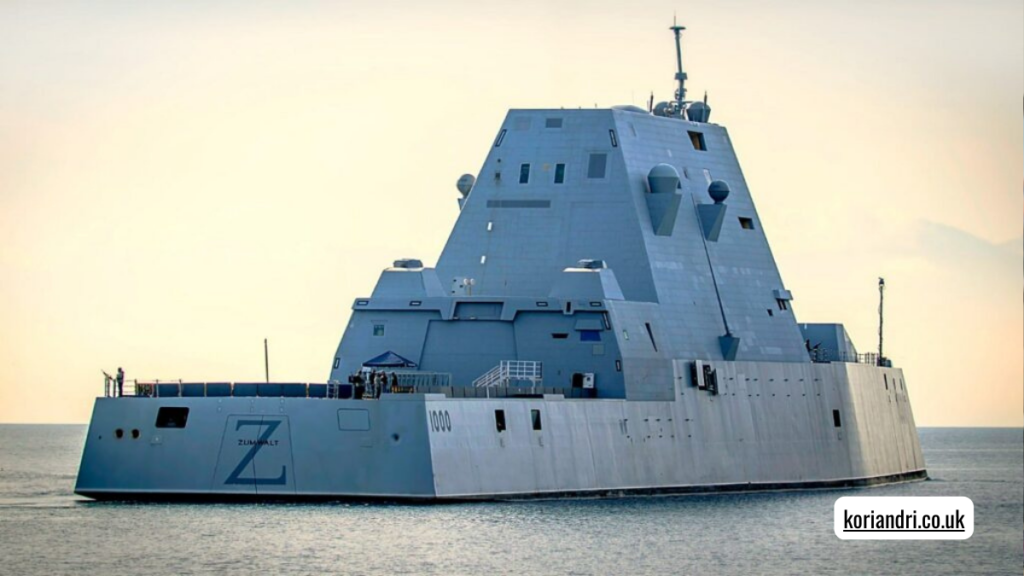

The USS Zumwalt represents one of the most ambitious and technologically advanced surface combatants ever built for the United States Navy. Designed to transform naval warfare through stealth architecture, integrated electric propulsion, and next-generation weapons systems, this futuristic destroyer stands apart from every warship that came before it.
Unlike traditional guided-missile destroyers, the USSZumwalt was engineered as a multi-domain strike platform capable of operating in contested environments while remaining difficult to detect. Its angular hull, composite deckhouse, and reduced radar cross-section mark a radical departure from conventional naval design. For analysts, defense planners, and maritime enthusiasts alike, this ship is both a symbol of innovation and a case study in modern military procurement.
Origins and Strategic Vision Behind the Program
The USSZumwalt program began as part of the U.S. Navy’s effort to rethink surface warfare in the post–Cold War era. Initially conceived under the DD-21 and later DD(X) programs, the goal was to create a land-attack destroyer capable of delivering precision firepower in littoral environments while surviving in high-threat scenarios.
The vessel is named after Elmo Zumwalt, a former Chief of Naval Operations who championed modernization and forward-thinking doctrine. The Navy envisioned a fleet of more than 30 ships, but shifting budgets and evolving strategic priorities ultimately reduced the class to just three vessels, making the USSZumwalt both rare and highly scrutinized.
Revolutionary Stealth Design and Tumblehome Hull
uss zumwaltThe most striking feature of the USS Zumwalt is its tumblehome hull, which slopes inward above the waterline rather than flaring outward like traditional destroyers. This geometry significantly reduces radar reflection, helping the ship appear much smaller on enemy sensors than its actual size.
Combined with an enclosed composite deckhouse and minimal external clutter, the design achieves a radar cross-section comparable to a small fishing vessel. In practical terms, this means the USSZumwalt can approach hostile shores or operate in contested waters with a dramatically reduced risk of early detection, altering the calculus of maritime engagement.
Integrated Electric Propulsion and Power Generation
At the core of the USS Zumwalt lies its Integrated Power System, a groundbreaking approach that generates electricity to power both propulsion and onboard systems. Unlike conventional mechanical drive systems, this architecture allows flexible distribution of energy to weapons, sensors, and propulsion as needed.
This system produces significantly more electrical power than legacy destroyers, creating future-proof capacity for advanced weapons such as directed energy systems and railguns. The ability to reallocate power dynamically enhances operational flexibility and positions the USS Zumwalt as a platform designed not only for today’s missions but also for tomorrow’s technologies.
Advanced Weapons Systems and Firepower Evolution
Originally, the USS Zumwalt was equipped with two Advanced Gun Systems designed to fire precision-guided Long Range Land Attack Projectiles. However, the ammunition costs proved prohibitively high, leading to the cancellation of the specialized rounds.
The Navy has since pivoted toward hypersonic weapon integration, transforming the USS Zumwalt into a potential long-range strike platform. By incorporating advanced missile capabilities, the destroyer shifts from primarily shore bombardment to strategic deterrence, enhancing its relevance in peer-level conflict scenarios.
Vertical Launch System and Missile Capabilities
The USS Zumwalt utilizes a Peripheral Vertical Launch System, distributing missile cells around the ship’s outer hull rather than concentrating them centrally. This design improves survivability by isolating potential explosions and minimizing cascading damage.
The ship can deploy a variety of missiles, including surface-to-air interceptors, anti-ship missiles, and land-attack cruise missiles. Compared with the Arleigh Burke-class destroyer, the USSZumwalt emphasizes stealth and strike innovation over traditional fleet air defense dominance.
Comparison with Arleigh Burke-Class Destroyers
To better understand the USSZumwalt’s place in the fleet, comparing it to established destroyer platforms provides valuable perspective.
| Feature | USS Zumwalt | Arleigh Burke-Class |
|---|---|---|
| Hull Design | Tumblehome stealth | Conventional flared hull |
| Radar Signature | Extremely reduced | Moderate |
| Primary Focus | Stealth strike, future tech | Multi-role air defense |
| Power System | Integrated electric | Gas turbine mechanical |
| Fleet Size | 3 ships | 70+ ships |
This comparison highlights the USS Zumwalt as a technology demonstrator and specialized platform rather than a mass-deployed fleet workhorse.
Radar, Sensors, and Combat Systems
The USS Zumwalt incorporates advanced radar systems designed for enhanced situational awareness. Originally equipped with dual-band radar capabilities, cost and integration challenges led to modifications in sensor configurations.
Even with adjustments, the ship’s combat systems remain highly capable, enabling detection, tracking, and engagement across multiple domains. Its architecture emphasizes network-centric warfare, allowing integration into broader naval task forces and joint operational frameworks.
Operational Deployment and Mission Evolution
The USS Zumwalt entered service in the mid-2010s and has since undergone operational testing, system upgrades, and evolving mission assignments. Early mechanical challenges and weapons reconfiguration shaped its trajectory, but the platform continues to mature.
Rather than serving purely as a coastal bombardment vessel, the USSZumwalt is transitioning into a high-end strike asset. Its stealth characteristics and potential hypersonic integration align it with emerging strategic deterrence missions in contested maritime regions.
Cost, Budget Challenges, and Public Debate
Few modern warships have generated as much debate over cost and value. With per-ship expenses reaching billions of dollars, critics questioned whether the technological leap justified the investment.
Supporters argue that innovation often carries high upfront costs but delivers long-term strategic advantages. The USS Zumwalt program illustrates the tension between experimentation and fiscal discipline in defense acquisition, highlighting the risks and rewards of pushing technological boundaries.
Technological Innovations Beyond Weapons
Beyond its combat systems, the USSZumwalt introduced automation features that significantly reduce crew size compared to older destroyers. Advanced monitoring systems, digital control interfaces, and streamlined logistics improve operational efficiency.
These innovations reflect broader naval trends toward automation and reduced manpower dependency. By operating with a smaller crew, the USS Zumwalt demonstrates how modern design can enhance sustainability and reduce lifecycle personnel costs.
Strategic Relevance in Modern Naval Warfare
As geopolitical tensions evolve, stealth and long-range precision strike capabilities become increasingly valuable. The USS Zumwalt offers a platform capable of penetrating sophisticated anti-access and area-denial networks.
In the Indo-Pacific region and other high-risk theaters, the ship’s low observability provides tactical advantages. Analysts view the USS Zumwalt as a bridge between traditional surface combatants and next-generation maritime warfare concepts.
Hypersonic Weapon Integration and Future Outlook
One of the most transformative upgrades underway involves integration of Conventional Prompt Strike hypersonic missiles. These weapons dramatically expand the range and speed at which the destroyer can deliver precision strikes.
If successfully deployed, the USS Zumwalt will transition from an experimental platform to a frontline strategic asset. This evolution underscores how adaptable architecture can extend a vessel’s relevance decades beyond its initial commissioning.
Industry Perspective and Expert Commentary
Defense analysts often cite the USS Zumwalt as a bold experiment in naval engineering. As one naval strategist observed, “Innovation at sea demands risk, and platforms like this define the boundaries of what’s possible.”
The ship’s journey demonstrates how military innovation rarely follows a straight path. Instead, it evolves through trial, refinement, and adaptation—qualities embodied by the USS Zumwalt program.
Broader Impact on Shipbuilding and Defense Industry
The technological breakthroughs achieved during the USS Zumwalt program influenced future ship designs and engineering standards. Integrated power systems, stealth shaping, and modular architecture now inform other naval projects.
Shipbuilders and defense contractors gained valuable experience in advanced materials and system integration. Even with limited production, the USS Zumwalt serves as a research catalyst shaping future maritime platforms.
Conclusion: A Symbol of Ambition and Adaptation
The USS Zumwalt stands as both a symbol of ambition and a testament to adaptation. While its original land-attack concept shifted over time, its technological foundations ensure continued relevance in an era of rapid military transformation.
In the broader narrative of naval innovation, the USS Zumwalt reflects the reality that groundbreaking advances often face turbulence before achieving clarity of purpose. Today, it occupies a unique position within the fleet—rare, controversial, and undeniably transformative.
FAQ
What is the USS Zumwalt designed for?
The USS Zumwalt was designed as a stealth-guided missile destroyer focused on precision land attack and advanced strike capabilities.
Why is the USS Zumwalt considered stealthy?
The USS Zumwalt uses a tumblehome hull and composite deckhouse to dramatically reduce radar signature.
How many USS Zumwalt ships were built?
Only three ships were constructed in the USS Zumwalt class due to budget constraints and evolving priorities.
Does the USS Zumwalt carry hypersonic weapons?
The USS Zumwalt is being modified to integrate hypersonic missiles, enhancing long-range strike capability.
How does the USS Zumwalt differ from other destroyers?
The USS Zumwalt emphasizes stealth design and integrated electric power rather than traditional air-defense dominance.