

The cost of higher education has reached a point where traditional part-time jobs—like working in retail or hospitality—often fail to cover the rising tide of tuition, books, and urban living expenses. For many undergraduate students, the search for a sustainable income stream has shifted from manual labor to intellectual labor. This transition has birthed a new generation of “student-entrepreneurs” who leverage their academic proficiency to fund their degrees. Specialized writing has emerged as the premier choice for those looking to balance a heavy course load with financial independence, offering a flexibility that a standard 9-to-5 simply cannot provide.
In the current academic climate, the pressure to maintain a high GPA while managing professional networking is immense. Many students find that their time is their most valuable asset, yet it is often consumed by repetitive administrative tasks or foundational coursework that doesn’t align with their long-term career goals. To navigate this, savvy learners have begun to treat their education like a business, understanding when to delegate and when to focus. For instance, when the sheer volume of paperwork becomes a barrier to actual learning, many turn to a professional assignment writing service at Myassignmenthelp to reallocate their hours toward high-impact internships or technical skill-building. This strategic approach to time management is no longer just a “hack”; it is a survival mechanism in a competitive global market.
The Evolution of the Academic Side-Hustle
Historically, students worked “blue-collar” jobs to get through university. While these roles taught discipline, they rarely contributed to a student’s professional portfolio. Today, the “Knowledge Economy” allows students to monetize exactly what they are already doing: researching, synthesizing information, and writing.
Specialized writing includes everything from technical copywriting and SEO blogging to academic tutoring and grant writing. Unlike flipping burgers, these roles sharpen the very skills students need after graduation. By writing for diverse industries, a business student learns market trends, a biology student stays updated on biotech innovations, and a law student masters the art of persuasive drafting.
Why Specialized Writing is Dominating 2026
- Location Independence: Work from a library, a dorm, or a café.
- Scalable Income: You aren’t paid for your time, but for your expertise.
- Portfolio Building: Every article published is a credential for your CV.
- Skill Synergy: The research you do for work often helps your own studies.
Strategic Financial Planning for Students
Managing finances as an undergraduate requires a mix of frugality and active income generation. The goal is to graduate with as little debt as possible while maintaining a lifestyle that supports mental well-being.
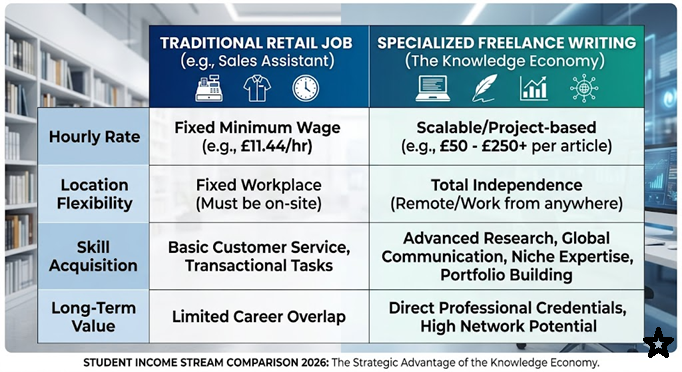
| Strategy Component | Traditional Approach | The Modern “Writing” Approach |
| Primary Income | Hourly wage (Fixed) | Project-based (Scalable) |
| Skill Growth | Low (Repetitive tasks) | High (Research & Synthesis) |
| Flexibility | Rigid shifts | Total control over deadlines |
| Networking | Limited to workplace | Global reach via digital platforms |
The Gig Economy: Writing as a Financial Pillar
As students look for ways to bridge the gap between their bank accounts and their tuition bills, the digital marketplace has provided a unique outlet. It is no longer uncommon to see high-achieving scholars offering their expertise to global platforms. For those with a flair for research and a command of language, the opportunity to write essays for money through Myassignmenthelp has become a legitimate way to build a financial cushion. This doesn’t just provide immediate cash flow; it forces the writer to engage with complex topics, improving their own critical thinking and speed—traits that are highly valued in the corporate world.
By engaging in specialized writing, students learn the nuances of “Global Tone.” They realize that writing for a UK audience requires a different cultural touch than writing for a US or Australian audience. This cross-cultural communication skill is something that cannot be taught in a standard lecture hall but is learned quickly when your income depends on it.
How to Scale Your Writing Income Without Burnout
One of the biggest risks for student writers is burnout. Balancing 15 credits of coursework with 20 hours of freelance writing requires a system.
1. Identify Your Niche
Don’t be a generalist. If you are studying Finance, write about Fintech. If you are in Engineering, write about Sustainable Infrastructure. Specialized niches pay 3x more than general “blog writing.”
2. Use Professional Tools
Leverage grammar checkers, SEO tools, and project management apps. Treating your writing like a professional agency operation will allow you to produce 1,400-word articles in half the time it takes an amateur.
3. Build a “Buffer” Fund
Use your writing income to create a savings account that covers at least three months of rent. This removes the “panic” of exam season, allowing you to take time off writing to focus on finals without financial stress.
The Long-Term Impact of Academic Entrepreneurship
The journey of funding an education through writing ends at graduation, but the benefits do not. Students who have spent four years managing clients, meeting deadlines, and translating complex ideas into readable content enter the job market with a massive advantage. They aren’t just graduates; they are proven professionals with a track record of reliability.
In conclusion, the path to a debt-free degree in 2026 isn’t found in a traditional paycheck. It’s found in the ability to turn knowledge into a commodity. Whether you are using a service to free up your time or providing your own writing expertise to others, the goal remains the same: a smarter, more efficient way to achieve academic and financial success.
Frequently Asked Questions (FAQ)
1. Is it possible to rank on the first page of Google with student-focused content?
Ans: Absolutely. By focusing on “long-tail keywords” (specific phrases like “how to fund a business degree through writing”) and providing high-quality, long-form content (1,200+ words), you can compete with larger sites.
2. How do I avoid looking “spammy” when including links in a guest post?
Ans: The key is context. Links should always serve as a “resource” for the reader. If the link helps solve a problem mentioned in the paragraph, it is viewed as helpful by both the reader and search engine algorithms.
3. What is the best word count for a high-ranking blog post?
Ans: In 2026, Google favors depth. Articles between 1,200 and 1,500 words tend to perform best because they allow for thorough exploration of a topic, which increases “dwell time.”
4. How can I balance writing jobs with my university exams?
Ans: Strategic delegation is key. Many students use academic support services during peak exam weeks to manage their workload, allowing them to maintain their grades while keeping their writing business or side-hustles active.
5. Does writing for money actually help my career?
Ans: Yes. It builds a portfolio of published work, demonstrates discipline, and hones your communication skills—all of which are top priorities for modern employers.
About The Author
My name is Charles Adkison, and I am an academic success strategist for Myassignmenthelp. With over a decade of experience in educational consultancy, I specialize in helping undergraduate students bridge the gap between rigorous coursework and career readiness.